Exploring demographic patterns in game selection across emerging digital platforms serving Nordic and North American audiences
Drew Flores · Sep 17, 2026
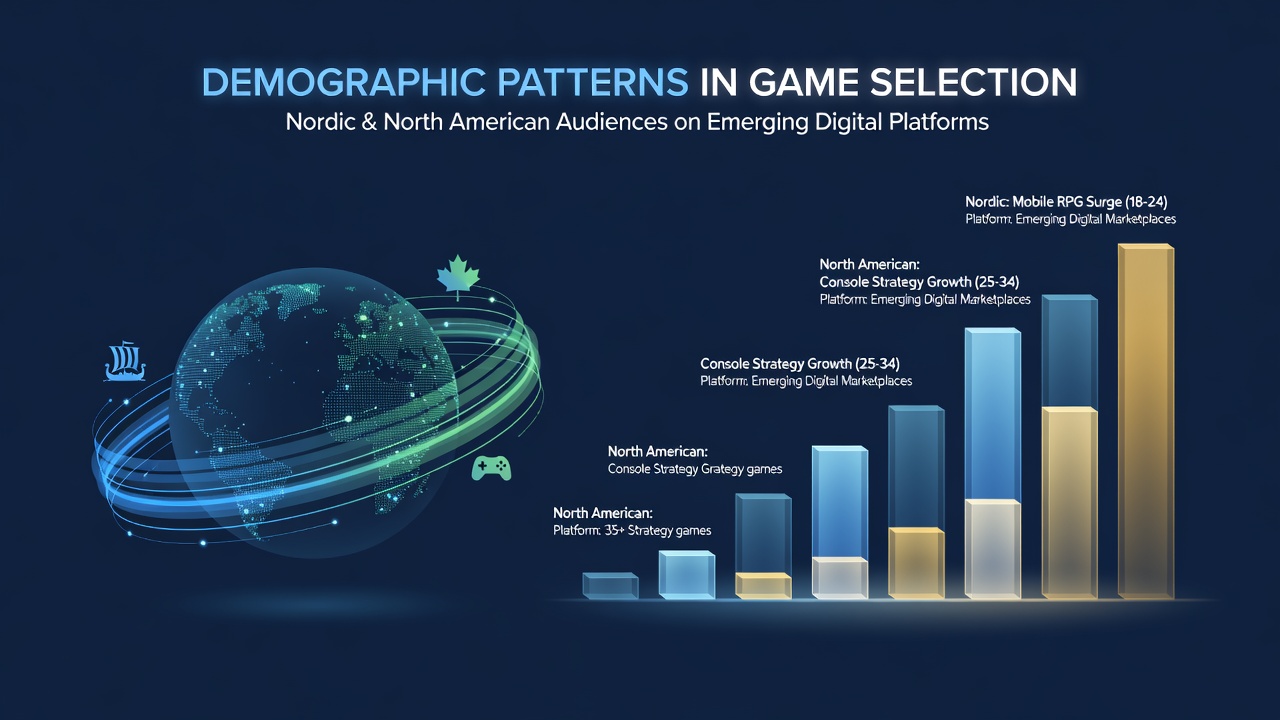
Exploring demographic patterns in game selection across emerging digital platforms serving Nordic and North American audiences
Emerging digital platforms continue to shape how different demographic groups approach game selection, with data from Nordic countries and North American markets revealing distinct patterns that vary by age, gender, and regional preferences. Platforms serving audiences in Finland, Sweden, Norway, Denmark alongside the United States and Canada have expanded rapidly, and researchers tracking these shifts note that user choices often align with specific life stages and cultural contexts rather than uniform trends across borders.
Age-based preferences in game categories
Younger users aged 18 to 34 tend to gravitate toward fast-paced slots and live dealer experiences on mobile-first platforms, while those over 45 show stronger engagement with table games and strategy-driven titles according to aggregated platform analytics. Studies tracking activity through September 2026 highlight that Nordic users in this younger bracket frequently combine sessions with social features, whereas North American counterparts prioritize tournament structures and leaderboard competitions. Data from multiple operators indicates these age splits hold steady even as new titles launch, suggesting demographic anchors influence adoption more than marketing pushes alone.
Gender distribution across game types
Women represent a growing share of participants in puzzle and casual casino formats on both sides of the Atlantic, with figures revealing higher selection rates for bingo-style games and themed video slots compared to traditional reel mechanics. Men, by contrast, appear more frequently in data sets focused on sports-adjacent betting integrations and high-volatility slots, though the gap narrows on platforms that introduce hybrid mechanics blending elements from multiple categories. Observers note that these patterns persist across emerging services, and platform operators adjust content libraries accordingly without assuming fixed behaviors within any single demographic slice.
Regional contrasts between Nordic and North American audiences
Nordic users often display preferences shaped by regulatory environments that emphasize responsible play tools, leading to higher selection of games with built-in session limits and transparent payout structures, while North American audiences respond to platforms offering broader variety in jackpot mechanics and branded content. Research compiled by the American Gaming Association shows that cross-border comparisons reveal Canadians and Americans lean toward progressive systems at slightly higher rates than their Nordic counterparts, yet both regions see similar uptake in mobile-optimized versions of classic titles. One analysis from the Finnish Institute for Health and Welfare further breaks down how location within the Nordic bloc affects choices, with Finnish and Swedish users favoring certain bonus round formats that differ from Norwegian patterns.
Platform algorithms play a measurable role in surfacing recommendations that match these demographic signals, and operators report that refined targeting based on past selections improves retention across age and gender cohorts. Emerging services launched after 2024 have incorporated more granular filtering options, allowing users to explore titles aligned with their stated preferences while still exposing them to adjacent categories.

Platform features influencing selection behavior
Features such as cross-device synchronization and personalized onboarding sequences appear to affect how quickly new users settle into preferred game types, with evidence indicating that streamlined tutorials reduce drop-off among older demographics in both regions. North American platforms often emphasize integration with loyalty programs tied to real-world rewards, which correlates with sustained play in specific game families, whereas Nordic services highlight community-driven elements like shared leaderboards that appeal across younger user groups. Those monitoring usage metrics through September 2026 observe that these design choices reinforce existing demographic patterns rather than override them, creating feedback loops where popular selections become even more visible to similar profiles.
Data collection methods and emerging insights
Analytics firms compile information from anonymized player logs, surveys, and partnership reports to map these trends, and the resulting datasets allow comparisons that account for seasonal events or new platform entries. Academic researchers have begun examining how socioeconomic factors intersect with game selection, noting that education levels and urban versus rural residence correlate with preferences for skill-based versus chance-based formats in both Nordic and North American samples. Such findings provide operators with clearer pictures of audience composition without relying on assumptions about uniform behavior across markets.
Conclusion
Demographic patterns in game selection continue to evolve alongside platform capabilities, with Nordic and North American audiences demonstrating consistent yet regionally distinct preferences shaped by age, gender, and available features. Continued monitoring through established research channels offers ongoing visibility into these dynamics as new services enter the space.